

Catch and release anxiety
The following blog consists of excerpts from my workbook chapters that can be found under the ‘workbook’ tab.
Too often an anxious thought seems to come out of nowhere, hijack our brain, and cycle through over and over. I’ve come to see my brain as a biological computer that is constantly reaching for something, anything, to do. The more I allow it to run on automatic, the more often this operating system can expand, pulling up programs that can include the anxiety module, spitting out thoughts like:
Things are calm, so let’s find something new to worry about.
Let’s repeat that old worry that feels so scary.
Let’s rehash the day to see where you might have made a mistake or embarrassed yourself.
Things are good. Get ready because this is what it’s like right before things go bad!
Our brains are needed and helpful, it’s true, but they should not be in charge of us. Our culture often pushes the idea that our brains are the best part of us—how often have we heard “Use your head!”
The bottom line is that our brains are glitchy, often prioritizing comfort and survival over accuracy. However, long term survival—physically and psychologically—often depends on accurate interpretation rather than immediate alarm.
Survival is obviously critical, but in normal day-to-day living in the modern world, accuracy can also be critical, more than we might imagine. This is because reacting fast is not always the same as reacting well. Long term survival—physically and psychologically—often depends on accurate interpretation rather than immediate alarm.
Anxiety is a prominent part of our experience (1 in 3 people in the U.S. have or will experience an anxiety-related disorder at some point) and most of us experience stress often enough that we commonly talk about ‘being stressed out’. The presence of anxiety, if it’s marked or generalized enough, can lead one to overestimate the likelihood of negative events and how costly they will be, and to underestimate our ability to cope if the event occurs. It’s also true that anxiety is painful, distressing, and pulls us away from ‘the good’ in our life.
Interestingly, and in contrast to how anxiety affects your thinking, another kind of bias is called optimism bias, which occurs in over 70% of individuals. Optimism bias leads to the belief that we are ‘in control’ and ‘it’ won’t happen to us.
What interests me is the possibility of a ‘sweet spot’ where we are not under or over-reacting to concerns.
Because our computer brains are too often ‘on automatic’, both diminishing threats or over-inflating them. I believe that it is very difficult for us to find the sweet spot. It is still good for us to try but to expect ‘trying’ to be a process. When we try, it is important for us to understand how our individual computer brain works, and the benefits and costs of the programs we’re running. It’s also incredibly helpful to gently release automatic thoughts, or our anxious computer brain programming, move into conscious awareness, and support an inner feeling of being more relaxed and gently positive.
So what happens when our brain hijacks us, when we don’t notice or are not willing or able to check it or balance it?
We then lean into feeling better by trying to be ‘in control’ in ways that are not possible, don’t really feel good, and don’t serve us.
What I’m not willing to do to feel less anxious: look at the world through a cloudy lens.
What I am willing to do: many things but, most importantly, gentle, self-compassionate brain retraining plus cultivating inner peace.
So let’s be self-compassionate and love on our Selves as we gently reflect upon a moment in which we’re feeling anxious.
Let’s try:
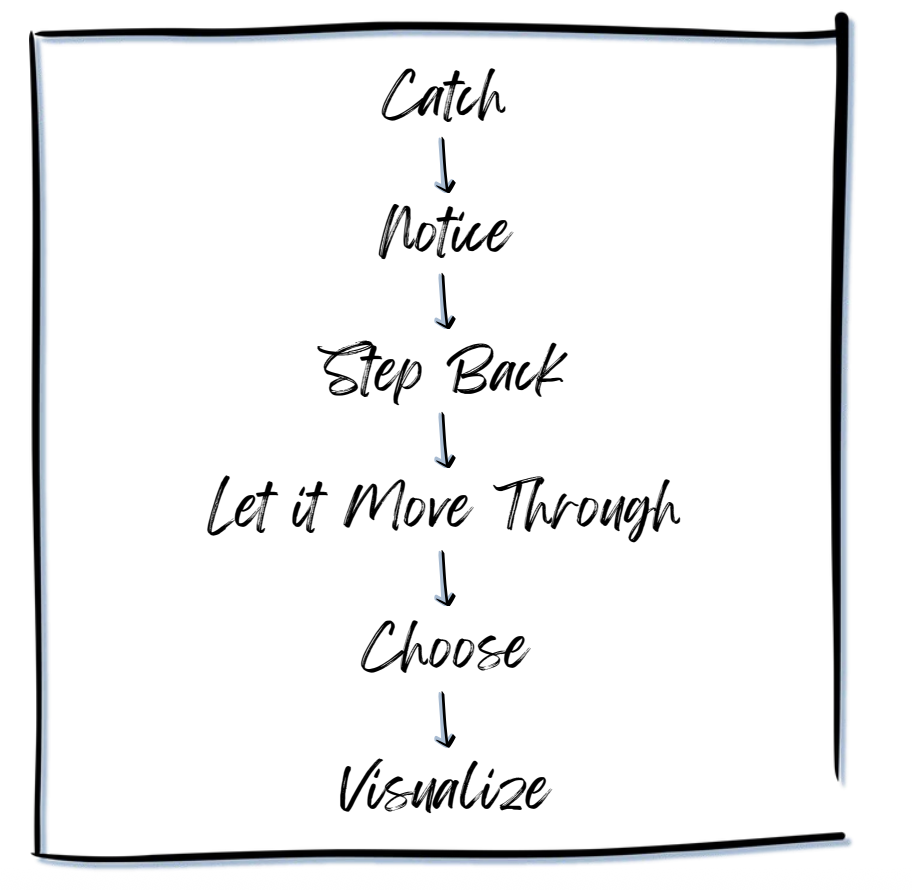
I honor the concern you’re bringing to my attention.
I care, and I will respond by consciously choosing an action or nonaction (being still, for example, or waiting and monitoring).
Then I will allow the concern to move through and past my awareness, and then move through again, as often as needed.
I will focus briefly on the positive visualization I’ve created.
I will ground in the felt sense of inner peace I’ve been cultivating
Remember, growth happens through gentle practice and repetition.
If our brains aren’t hijacking us by playing ‘let’s control life’ programs, then we can enter and then live in a more mindful place.
The Catch & Release
When our brains ‘catch an anxiety’ and relentlessly replay it in full living color, over and over, complete with programs that spin scary scenarios and possibilities, complete with thoughts like the following, we lose so much.
I can’t prevent this.
My loved one will be seriously hurt or even die.
If only I could do this or if only I could do that to prevent this feared outcome.
I’m such a bad person, friend, or mother/father that I didn’t (fill in the blank).
I’m completely overmatched by all the scary things that can happen.
I’m helpless as I think about this danger.
I’m overwhelmed as I think about this danger.
As we watch our brains catch these thoughts, we can step back from these thoughts. We then have some separation from our brain as we listen to the negative possibilities our brain generates. We may act upon them if they are reasonable and action is called for. Otherwise, we release them; then we release them again, and re-release them gently and as often as we need to.
The Practice
Maybe the Most Important Thing: Trust Yourself.
This is the process: Every time your mind ‘catches’ an anxiety, say “Here it is, here’s my anxiety,” step back and create some space between you and your anxiety, and between you and your brain. Let the anxiety move through your awareness, and move through your awareness again, as often as is needed.
Think of all the things you were anxious about in the past and see that you are competent, empowered and impactful…but not in control.
Copyright © 2026 Dr. Julie E. Waters, Psy.D.
To learn more about steps you can take to ‘catch and release anxiety’, download the free workbook under the ‘workbook’ tab, linked here.